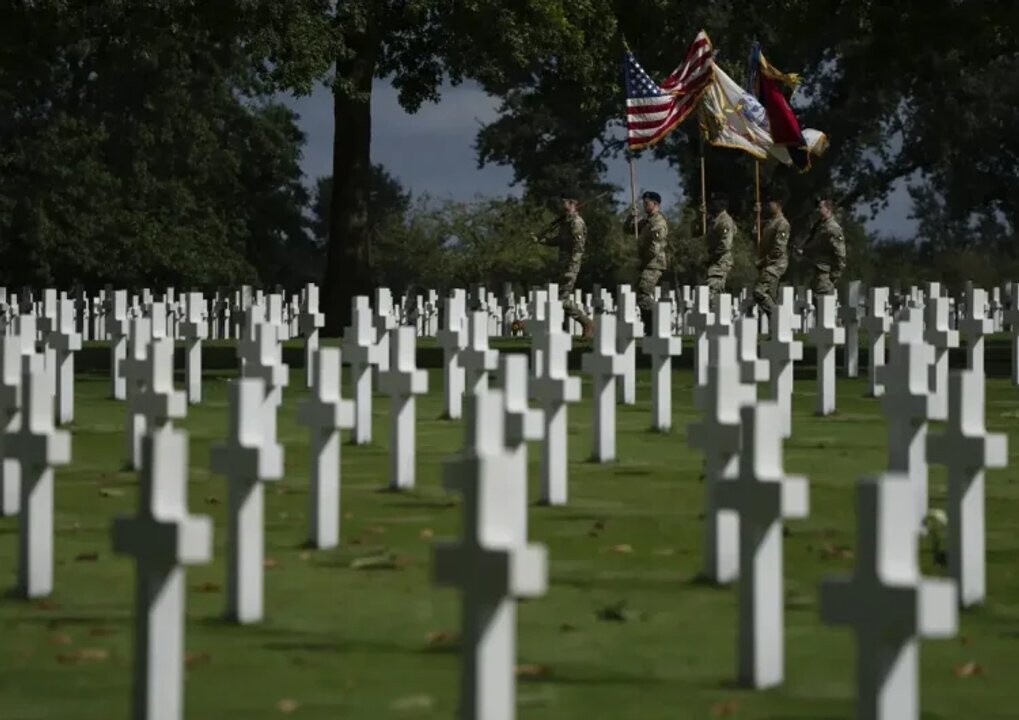
The American Battle Monuments Commission (ABMC) has announced its decision to return informational panels about African American soldiers to the exhibit at the visitor center of the Netherlands American Cemetery. The panels were added to the visitor center in mid-2024, partly due to the efforts of the then U.S. Ambassador to the Netherlands, Shefali Razdan Duggal. American troops fought there between 1944 and 1945, and the U.S. Embassy in the Netherlands describes the southern Limburg region as the country's most “Americanized” area. “The exhibition at the Netherlands American Cemetery honors the service of the American military personnel interred or commemorated there, regardless of their race, creed, rank, or origin; a direct reflection of the composition of our cemeteries,” stated the ABMC. Dutch legislator and chair of the Black Liberators project, Theo Bovens, told Newsweek: “We hope the panels return, given the importance of the contribution of African American soldiers to the liberation of the Netherlands.” Local and provincial authorities are studying plans for a possible alternative monument, according to Dutch media. The Black Liberators project indicated that one of the panels detailed the life of George H. Pruitt, a telephone engineer from New Jersey who died in 1945 while trying to rescue a fellow soldier from a river in Bremen, northwestern Germany. He was 23 years old. The second panel provided information on the strict segregation policy in the U.S. Army during World War II and the participation of many soldiers in the post-war civil rights movements. Some 1,700 soldiers, officially considered missing, have their names inscribed on the cemetery, according to the American Battle Monuments Commission (ABMC), the U.S. agency responsible for the Dutch site. A total of 174 African American soldiers are buried or commemorated in Margraten, according to the Dutch Black Liberators research project. It is the only American military cemetery in the country. Earlier this month, Dutch media reported that two informational panels about African American soldiers in the mid-20th century war had been removed from the cemetery's visitor center. Commemorative plaques of African American soldiers who fought against Nazi Germany in Europe have been removed from an American military cemetery in the Netherlands. Approximately one million African American soldiers fought in Europe during World War II. More than 8,200 Americans are buried at the Netherlands American Cemetery, located in the town of Margraten, east of Maastricht. The U.S. Army was officially desegregated in 1948. “The panel dedicated to Technician Fourth Class George H. Pruitt is currently out of exhibit, though it continues to rotate,” stated the ABMC. In March, Arlington National Cemetery removed references to the history of Black military members and women from its website, and the Pentagon, that same month, restored a webpage commemorating U.S. Army Major General Charles Calvin Rogers, decorated with the United States' highest military honor and a Black Vietnam veteran, after outrage over its removal. The ABMC told Newsweek that the Margraten visitor center had 15 magnetic panels “designed to be removed and rotated during the exhibit in order to highlight as many individual stories as possible.” A local official, who requested anonymity to speak freely, told Newsweek that the ABMC did not inform the authorities of the province of Limburg, where the cemetery is located, about the removal of the panels. A spokesperson for the Black Liberators project separately confirmed to Newsweek on Monday that the panels had been removed and were currently not on display. It is unclear when the panels were removed. The commission staff “has developed a periodic rotation program to include new content for visitors,” added. The ABMC removed in March a panel that included a quote from the African American soldier, First Lieutenant Jefferson Wiggins, continued the commission, following an internal review of interpretive content conducted under the direction of the former ABMC secretary. The ABMC's response “might explain the removal of the story of Technician Fourth Class George H. Pruitt, even though it was the last one to be added, but it does not explain why the panel highlighting racial segregation was removed,” stated the Black Liberators project. The cemetery itself symbolizes the participation of the United States alongside Dutch fighters toward the end of the war, and it is a place where many people travel to pay their respects, stated Kees Ribbens, lead researcher at the NIOD Institute for War, Holocaust and Genocide Studies in Amsterdam. African American soldiers often performed manual labor or support roles in the army during World War II and helped build the Margraten cemetery from late 1944, explained Ribbens to Newsweek. Families could choose whether to leave the remains of their loved ones there or repatriate them to the United States when the cemetery was remodeled a few years later, explained Ribbens. “For people, the fact that the graves are still there has great meaning.” The Netherlands were officially liberated from Nazi occupation in May 1945, five years after the German invasion. The local official stated on Monday that they had found out about the removal of the information from the exhibit the weekend before. “Guessing the motives” “We have to guess the motives,” expressed Dutch legislator and chair of the Black Liberators project Theo Bovens. The White House, under the presidency of Donald Trump, has restricted diversity and inclusion programs, a stance that Secretary of Defense Pete Hegseth repeated in his restructuring of the Pentagon and U.S. Armed Forces. However, the project stated that they were removed again in early summer.